

Millions of iPhones, TVs and other devices could go offline Thursday — here's why [updated]
Millions of iPhones, TVs and other devices could become offline Thursday — here's why [updated]
UPDATED to add together that some devices were already starting to see connection issues on the evening of Sept. 29, and listing of services with issues on Sept. 30.
Old Macs, iPhones, PlayStation 3 and Nintendo 3DS gaming consoles, an unknown number of smart TVs, set-peak boxes and other "smart" devices, and even some PlayStation 4s may lose some internet connectivity this calendar week.
That's because a widely used digital certificate used to verify secure internet connections expires on Sept. 30, and millions of older devices won't be able to update to install newer certificates.
- Windows 11: What information technology ways for gamers
- The best Mac antivirus software you lot can get
- Plus: x million Android users hit by money-stealing malware — what to practice
As a consequence, many activities that requires a secure net connection — from watching Netflix to checking your email to reading regular websites — may not work on older devices.
If this sounds familiar, information technology's considering nosotros got a heads-up back in June 2020 when security researcher and consultant Scott Helme warned of information technology on his blog. Later in 2020, information technology was estimated that one-third of all Android phones could exist knocked offline.
"You may or may non need to do annihilation nearly this," Helme wrote on his blog in an update last week, "just I'm betting a few things will probably break on that twenty-four hours [Sept. 30]."
What you can do to keep your older devices online
Fortunately for those older Android devices, a workaround has been devised to keep them upwardly and running until September 2024 every bit long equally they've got Android 2.three.6 Gingerbread or afterwards. (Afterward 2024, you lot'll need at least Nougat 7.1.1.)
But that doesn't help Macs running macOS 10.12.0 or before, iPhones and iPads running iOS nine or earlier, PlayStation 4 consoles running firmware versions earlier than v.00 and old PCs running Windows XP with Service Pack two or earlier. All are likely to be affected, according to this list of affected devices posted by the digital certificate potency Let's Encrypt.
If you have one of these devices and tin can upgrade the OS or firmware, practice so this week. For example, whatever PC running Windows XP SP2 can be upgraded to XP SP3, which will fix the issue. Macs need but upgrade to 10.13 High Sierra, and any iPhone v or subsequently tin install iOS ten. PS4s are already up to version ix.00, released but a few days agone.
PlayStation 3 consoles may or may not be able to be upgraded. Sony released PS3 firmware update 4.88 for the PS3 in June 2021, nearly fifteen years after the console was first fabricated available. We don't know what's in the firmware update — Sony just said it brought "additional features, improved usability and enhanced security" — but it'south possible it fixes this certificate issue. [Update: Our fully updated PS3 worked merely fine on the afternoon of Sept. thirty, afterwards the certificate expiration passed.]
If you can't upgrade your Mac, PC or iPhone, then you lot can install the Firefox web browser to maintain some level of cyberspace access, although standalone apps may not work. Unlike other browsers, Firefox isn't dependent on the device's OS for its security certificates — it brings its own.
As for smart Idiot box, smart refrigerators, smart-dwelling hubs, home Wi-Fi routers and so on, information technology's hard to tell. Odds are that many devices released before 2017 may be affected, specially if they've never received a firmware update.
So if you lot can, open upwards or download the instruction manuals that came with your devices and endeavor to upgrade the firmware or operating organisation.
What the heck is going on here?
This is complicated, but all those billions of secure internet connections that take identify worldwide every 2nd depend on what'south generally referred to equally a "concatenation of trust."
When a server — say a website — connects with a client like your PC, each presents digital certificates affirming identity. Because of this, your browser knows that it's connecting to Chase Bank and non some hacker subcontract in Russia.
Simply how exercise you know these digital certificates are valid? Well, certificates depend on public-private fundamental cryptography to prove there's no forgery taking place, but that'south some other issue. What also matters is that a higher authority affirms if that certificate was indeed issued to Chase Bank. And another authority vouches for that say-so, and so on.
Eventually, you reach the end of the line and get to what'due south called a root certificate. These are the backbone of encrypted web connections. Root document issuers take no one higher to vouch for, because it's the ultimate trust authority, and root certificates can be valid for many years.
Okay, so....
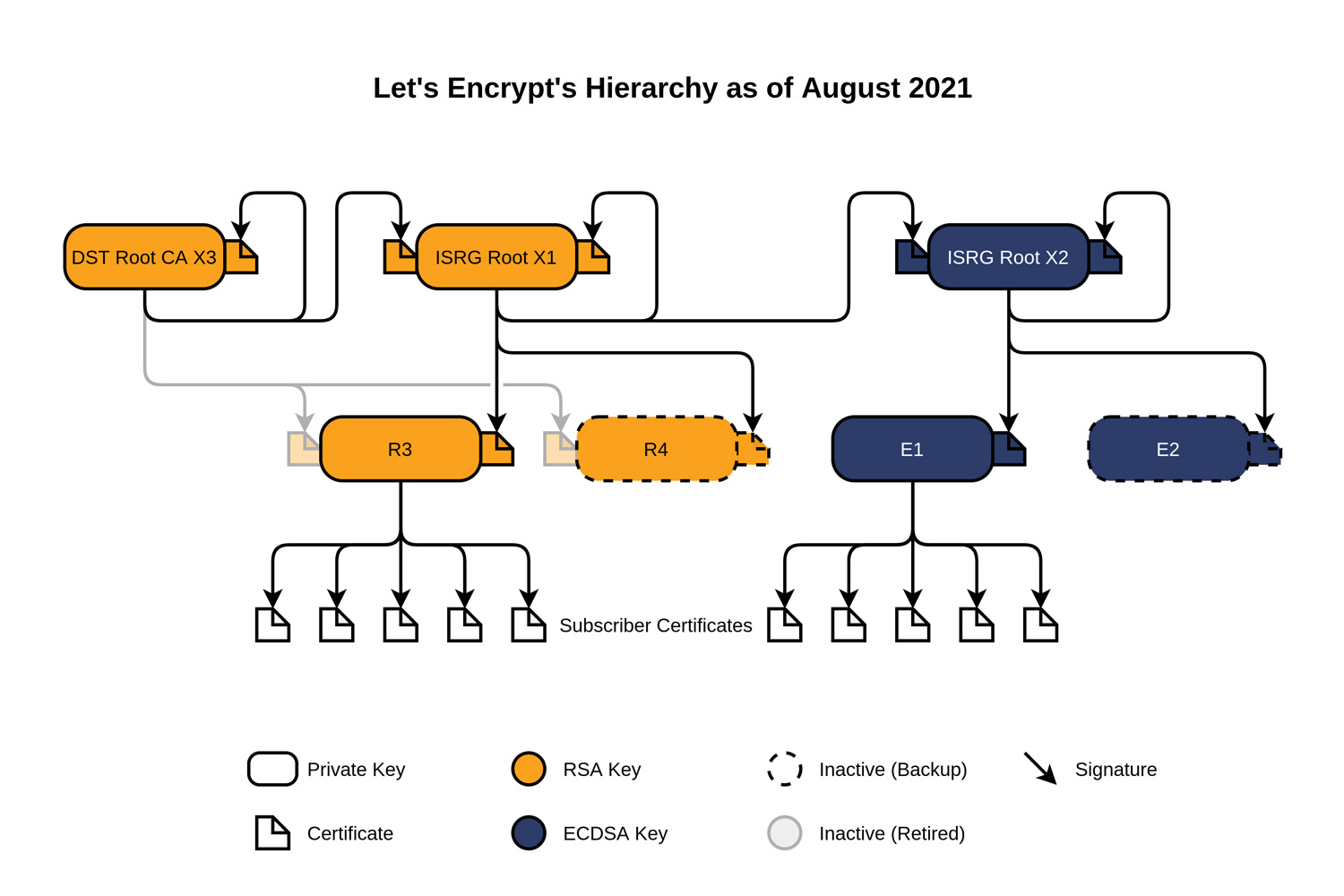
But like all certificates, root certificates somewhen expire. And i very important one, called DST Root CA X3, expires Sept. thirty, 2021. This root document is doubly significant considering it "cross-signs" or validates another root document that's even more than widely used and called ISRG Root X1.
ISRG Root X1 is cantankerous-signed considering the authorization issuing it, Let's Encrypt, was make-new in 2015 and equally such, wasn't widely trusted by browsers and devices. So it got the older, more widely accepted DST Root CA X3 to vouch for information technology and essentially tell devices that, "if you lot trust me, you can trust this i as well."
Technically speaking, ISRG Root X1 was performance as an "intermediate" document while DST Root CA X3 was acting as the root document. For more than on all how this works, Let'due south Encrypt has a handy explainer, and here'southward a possibly baffling diagram.
Since 2015, Let's Encrypt has rapidly grown to go the largest certificate authority in the world. One big reason is because it'due south gratis to use. Since 2015, nearly web connections have also get fully encrypted, and Allow'due south Encypt is a big reason for that.
Hence, the very first root certificate Let's Encrypt issued, ISRG Root X1, is very widely used to vouch for thousands, maybe millions, of shorter-term certificates used past websites and servers.
In fact, until the release of ISRG Root X2 in September 2020, information technology was the only root certificate Let'south Encrypt had issued (and it even cross-signs the newer certificate). Many newer devices accept received updates that permit them trust the ISRG Root X1 root certificate past itself, which is good because it's valid until June 2035.
Only a lot of older devices yet rely on the cantankerous-signing root certificate, DST Root CA X3, to vouch for ISRG Root X1. And that'south a problem because when DST Root CA X3 expires Sept. 30, 2021, and then those devices will no longer trust ISRG Root X1 or the jillions of downstream certificates that depend on it either.
Volition I lose all net connections?
Information technology's hard to say what this will hateful for devices that haven't been upgraded to trust ISRG Root X1. There are a couple of hundred valid root certificates in being, and virtually devices and web browsers will back up at least a few dozen.
So many older devices may however be able to make at to the lowest degree some spider web connections if those individual server certificates don't lead back to ISRG Root X1 or DST Root CA X3.
However, ISRG Root X1 besides backs version i.02 of OpenSSL, a widely used (considering it's free) software library that establishes secure web connections. OpenSSL version 1.02 was issued in early on 2015, and a lot of devices and operating systems released in 2015 and 2016 — such as iOS 9 and macOS ten.12 Sierra — rely on it.
Again, we won't really know what's going to happen until information technology starts to happen on Sept. 30. But Scott Helme thinks something definitely will.
"I don't know what's floating effectually out there on the web, and I don't know what depends on those things [each document] either," Helme wrote on his blog. "One thing that I do know, though, is that at least something, somewhere is going to break."
Update i: Windows servers may as well be afflicted
On Sept. 21, Helme updated his blog mail to note that "I've added IIS to the 'unsure' list equally some reports suggest manual intervention is required for a smooth transition."
IIS is Cyberspace Information Services, MIcrosoft'due south widely used web-server software. Although IIS, which debuted in 1995, gets regular updates and upgrades, some of Helme's Twitter followers pointed out that Windows servers that have been running for many years volition continue to use the aforementioned certificate "stores" even if they get software updates.
So I actually did a bunch of naive testing on Windows servers (to test if the decease would be a trouble) and establish that the reply (for windows) was a resounding perchance. Moving the R3 issued past DST Root CA X3 into untrusted helps forcefulness windows to serve the R3 to ISRG X1 chain.September 21, 2021
So an IIS-based server that's been running since, say, 2010, might even so take the same certificates it did and so, even if it's been updated several times. If so, then information technology's going to take problems connecting to some client devices (such PCs and smartphones) on Sept. xxx.
One poster helpfully posted instructions on GitHub on how to clear out the erstwhile certificates.
IIS needs special attention as it will serve the one-time chain unless you forcefully remove the intermediate R3 cert that's about to expire also. Hither's how to do it: https://t.co/Gb3D4qKLxXSeptember 21, 2021
None of this is data that should directly concern the average internet user, but if some of your favorite sites or online services go night on Sept. 30, this might exist why.
Update 2: Some outages occurring already
Helme tweeted on Wed evening U.k. time (Sept. 29) that some outages were already first to occur because an older Let's Encrypt intermediate certificate expired about 20 hours before the DST Root CA X3 root certificate that anchored information technology.
🚨🚨🚨 5 minutes until the Let'due south Encrypt R3 intermediate expires 🚨🚨🚨29 September 2021 19:21:40 UTCSeptember 29, 2021
Helme said he'd heard that some proxy services run past Bluish Coat, Cisco and Palo Alto networks were having trouble connecting.
He had also apparently received "many reports of iOS and macOS versions newer than expected seeing issues on sites serving the expired R3 intermediate. I've seen errors on iOS xi, xiii and 14 forth with several macOS version merely a few minor releases backside electric current."
As a couple of other Twitter users predicted a few days ago, Windows servers were indeed having issues, as indicated in the most recent posts on this Permit's Encrypt discussion thread.
This story was commencement posted Sept. 22.
Update 3: Behind-scenes outages
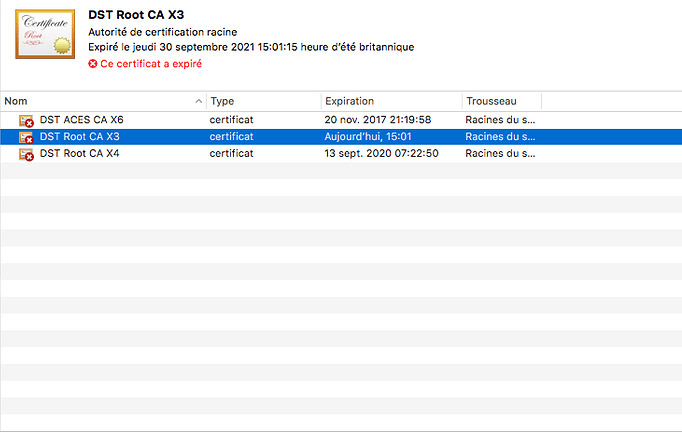
The DST Root CA X3 certificate expired at virtually 3 p.thou. London time, 10 a.m. New York time, on Thursday.
Four hours afterward, most of the reports of problems are coming from website operators, networking providers and even due east-commerce and electronic mail providers, including Cloudflare, OVH, Netflify and Fortinet, as chronicled by Helme in a series of threaded tweets.
Bad twenty-four hours for email besides, non just the Web. https://t.co/6OoteS4W9zSeptember 30, 2021
Some other bug were reported on the Permit's Encrypt discussion forum, especially from some Mac users. Even users of Big Sur reported bug.

Source: https://www.tomsguide.com/news/internet-disconnect-sept-30
Posted by: wernerpras1965.blogspot.com
0 Response to "Millions of iPhones, TVs and other devices could go offline Thursday — here's why [updated]"
Post a Comment